
AI in Legal Practice

Amy Swaner
Calculating...
Executive Summary
Women have traditionally been paid less than their male counterparts, and have handled the majority of the home and childcare. With AI on the scene, has any of that changed? It’s a mixed bag. While AI’s compounding productivity advantages may widen gaps for women lawyers who already shoulder disproportionate household and caregiving responsibilities, the same tools can also expose systemic inequities, reform compensation structures, and accelerate substantive expertise for women at all career stages. AI-driven efficiencies—particularly in document review, case management, and knowledge access—can ease maternity transitions, support remote work, and empower small or women-led firms to help level the competitive playing field. Ultimately, AI’s impact on women in law remains to be seen. There are several things firms and women legal professionals can do to help:
Firms:
* include women and other minorities on technology or AI committees
* use AI to measure contributions to firm success for a more equitable pay structure
* encourage all lawyers to use AI appropriately, avoiding problems
Women Legal Professionals:
* learn AI. Become the AI expert. Be the one leading the charge for AI adoption at your firm, even if you have to pay for outside training yourself
* Take advantage of AI handling the repetitive, mundane, and non billable tasks so you are free to focus on substantive legal work—either for the firm you work for, or the firm you start yourself.
I went to law school as a single mom. My baby was one—keeping me up teething all night during 1L finals-- and my older child was three. I had no family support nearby, and not nearly enough financial resources. But wait, it gets better. I got divorced my first year of law school. And the person I got divorced from--a very smart, attractive, charismatic man—was in my law school class. There are precious few situations I can imagine that would be worse for attending law school.
Having graduated 25 years ago, there were not many technical advances that I could use to my advantage. Thankfully, my law school was technology-minded. My school required laptop computers, allowed finals testing on computers, and even had a parents’ room where I could go and listen to my classes, kids in tow, when childcare fell through. Not the ideal way to attend law school, but I graduated with honors.
It's not surprising that I have a keen desire to help women, especially women in the legal profession, who still, nearly 30 years later, carry a disproportionate share of the household responsibilities. More than once in my schooling and professional career, I envied the student, co-worker, or opposing counsel who could spend time studying for finals or billing hours, unfettered by childcare, shopping, cooking, cleaning and running errands.
Sam Altman, Dario Amodei and other AI founders have extolled the virtues of AI; of how it should be human centric, values aligned, and useful. Which leads me to ask: AI, what have you done for women since you sprang onto the scene three years ago? Three years might not seem like a lot of time to make a measurable impression, but it is light years in AI-time. We need to be asking what has AI done not only for women, but for single parents, those disadvantaged by poverty, ill-treated for their sexual orientation, or distained because of race, age or religion. In this article, however, we’re focusing solely on women.
What Has AI Done For (Or To) Women?
What affect has AI had on women lawyers? I was asked this question recently at a women lawyers CLE retreat. I was taken aback, having not considered the question. So, I dug deeper to find the answer. For the past century, women have typically been paid less, valued less, heard less, and made less of an impact on notable historical events. Has AI had an impact on that? And if so, has it hurt the cause of women, or helped it?
How AI Can Hurt the Cause of Women Professionals
Technological advances can always be used for both good and ill. Here are some concrete ways it can harm women legal professionals.
The Compounding Effect
Women lose an average of 1-2 hours daily to household management. Stated another way, women in the U.S. perform roughly 2 more hours per day of unpaid household and care work than men. Let’s imagine a male and female lawyer named Brad and Angela, respectively. They work at the same firm, and both started on the same day with identical qualifications. Brad works about 10 hours per day, and Angela works 9. During Brad’s extra hour of work daily, or 20 hours per month, Brad spends his time mastering advanced AI features, prompt engineering, and tool integration. He develops better workflows and custom automations. He can experiment with multiple tools to find optimal combinations. He can set up custom GPTs and learn best practices.
AI has a compounding effect so that as Brad uses AI and gets more experienced, his extra 20 hours per month can turn into an extra 60 hours of productivity using AI for tasks. As Brad spends his extra 20 hours in a month learning AI techniques and best practices, two things happen:
Brad is seen as the AI expert, giving him credibility and enhanced skills, and perhaps even more desirable projects or recognition at the firm.
Brad leverages his knowledge of AI, using it to handle routine tasks, and specifically nonbillable tasks. This has a compounding effect. Brad’s extra 20 hours the following month turn into 40 or 60 extra hours of billable time.
Maybe the firm gives firm-wide AI training, and Angela learns how to use AI for tasks as well. But she has one less hour per day of time. Her working time is not amplified like Brad’s is. Brad’s extra hour allows not just more production but better leverage of the technology itself. With AI’s compounding effect what was one hour per day difference in time spent, now has the effect of Brad accomplishing exponentially more each day than Ali is able to accomplish.
This is even more noticeable in areas of practice with flat rate or percentage-based fees. There is a finite amount of time that must be spent on non-billable tasks, and a finite number of hours that can be ethically billed per day. But on flat rate or percentage-based work, there are no such constraints. These attorneys who embrace AI are rewarded with both the ability to accomplish much more, as well as the ability to do so more quickly. With the time savings they enjoy by effectively using AI tools, they can either create a better home-life balance, or put their saved time into additional matters, and enjoy higher revenues.
Walking Out the Door Syndrome
The “Walking Out the Door Syndrome” describes a particularly insidious pattern: women lawyers disappear from firms precisely when their experience becomes most valuable. This isn’t the dramatic exodus of burned-out first-years; it’s the quiet hemorrhaging of seventh-, tenth-, and fifteenth-year attorneys who have weathered the associate gauntlet only to find that partnership is not the promised land they envisioned. Women now make up around 56% of law students and just over 40% of all U.S. lawyers, but in large and midsize firms they account for only 28.83% of all partners and 24.8% of equity partners. In other words, women are a slim majority of associates (51.62%) but drop to about one third of non-equity partners (34.3%) and only one quarter of equity partners; a steep leakage that accelerates at each promotion point.
The Syndrome may well be intensified with the arrival of AI. Why? Because technology efficiency gains historically (pre-AI) get absorbed into higher billable targets rather than work-life flexibility, while deployment decisions—for AI, which tools to buy, how to implement them, who gets training—remain concentrated among the predominantly male partnership ranks. We must be thoughtful as we implement AI technology that it is being used to everyone’s best advantage, without fear of it making a tricky situation worse.
The Perception Gap
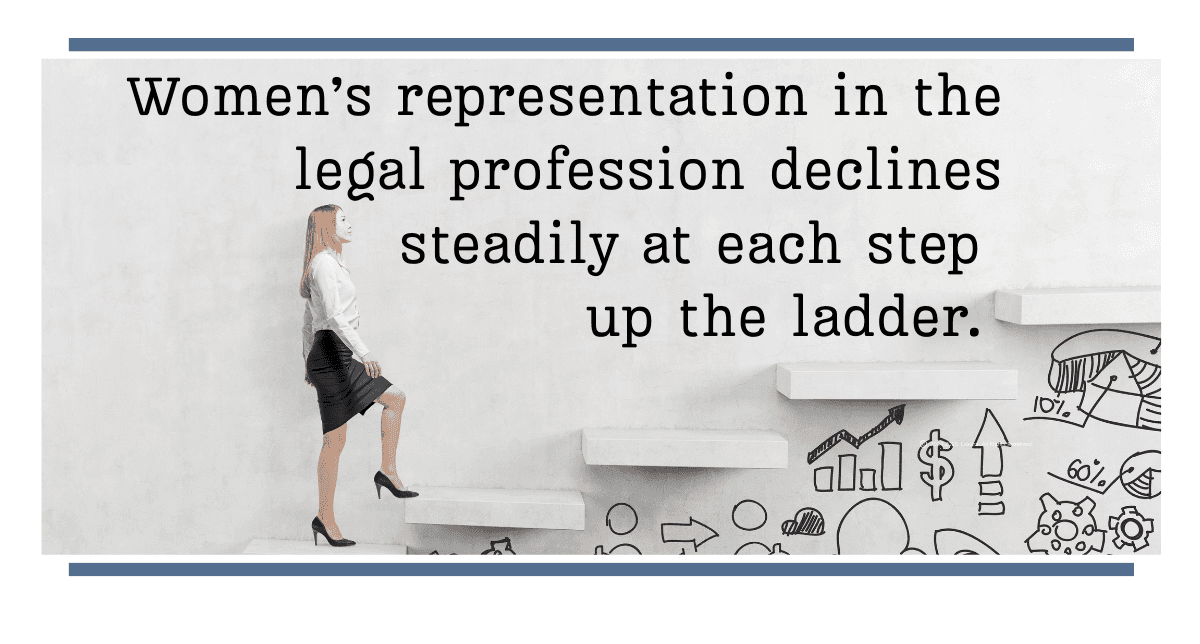
There is a perception gap between what experienced male lawyers and experienced female lawyers see as the situation at work. It is striking. According to an ABA study, 82% of managing partners and 91% of experienced men said their firms are active advocates of gender diversity, but only 62% of experienced women agreed. Similarly, 84% of managing partners believed their firms had succeeded in promoting women into leadership, compared to 55% of women. The National Association of Women Lawyers (NAWL’s) 2022 Annual Survey on the Retention and Promotion of Women in Law Firms paints the same picture over a longer time horizon: despite years of initiatives, women’s representation declines steadily at each step up the ladder.
______________________________________________________________________________
How AI Can Improve the Cause of Women Professionals
There are also some concrete ways that AI can benefit women legal professionals.
Reforming Systems
Walking Out the Door Syndrome is not a story about women failing to be resilient. It is a story about systems. AI will not fix those systems on its own. But if firms treat AI as a way to make invisible patterns visible—and then actually act on what they see—it can become one of the most powerful tools firms have to keep promising young and experienced women lawyers in the room, instead of watching them leave.
The ABA’s related work on why women leave firms points directly at “blatantly unfair” compensation systems and business-development credit as key drivers of departure. AI can help firms quantify and correct those patterns instead of relying on anecdotes. To do this, firms can use AI tools to quickly analyze time entries, email traffic, document authorship and client contact data to give a more accurate picture of who is doing the work and maintaining client relationships. That, in turn, can:
Inform fairer origination-credit and client-succession decisions
Identify situations where women are doing substantial uncredited work behind the scenes
Support compensation reforms that reward actual contribution rather than office reputations
This method of analyzing productivity can benefit all groups who feel excluded or as though they are the victim of “blatantly unfair” compensation systems.
Efficiency Gains
AI has brought universal efficiency gains. Here are just a few:
AI is ideally suited to document review and discovery automation, which traditionally have taken a significant amount of time.
Contract analysis tools enable faster turnaround without weekend/evening work, potentially supporting work-life integration.
AI allows access to knowledge bases at any time of the day or night, from any location, so that associates are not stuck nearly as often, waiting for ‘face time’ with a partner for the same level of instruction required previously.
Quick and easy editing and polishing of documents can boost morale and self-confidence of associates, which may provide an additional level of self-esteem, in addition to boosting more senior attorneys’ perception of an associate.
These efficiency gains have reduced hours spent on repetitive tasks that historically fell disproportionately to junior associates, where women are well-represented. As more basic and repetitive tasks are covered by AI, women can spend more time on more substantive work. This brings additional prestige and respect to female attorneys.
Easing Maternity Leave
Maternity leave can be exceptionally stressful for a woman wanting to maintain momentum in her career. AI can ease both preparing for maternity leave, as well as returning from maternity leave. By helping with case documentation, preparing polished summaries of cases and automated workflows, attorneys starting maternity leave can do so with more confidence, having ensured that their clients’ needs are being met.
Even re-entry back to full time work can be made more comfortable by AI summaries. Female attorneys can quickly get a recap of where each case stands, and other pertinent details. They can even ask for suggested next steps in any given case, as they transition back into their cases.
Firm Leveling
AI is primed to give women more options. One lesson, acknowledged during the pandemic, is that women with small children value remote work options. AI-powered practice management tools have made remote work more viable. Now, the biggest hurdle to having that option is firm preference; whether the firm requires a certain amount of in-office face time.
AI can also provide a more level-set playing field. AI tools allow smaller practices--where mothers are overrepresented compared to fathers--to compete with larger firms. With the assistance of AI, smaller firms have an exponential boost in using AI tools. For example, a larger firm, with the more well-funded client, may have had the time and resources in the past to create numerous documents. In order to avoid losing the issue by waiver, the smaller firm had to respond to all the legal filings. Now, smaller firms can manage extraneous filing much more easily. They can have AI review every filed document, prepare “sufficient” responses to the more groundless documents, and use AI assistance for the more substantive ones.
And what I consider to be the biggest advantage: enabling women to start a lucrative, viable law firm on their own terms. Even before AI, women have switched to smaller firms or started their own in order to gain more autonomy and control over their work schedules. AI makes this an even better prospect. It enables anyone wanting to start their own firm by decreasing the cost of start-up and allowing for faster acceleration. They can significantly reduce overhead expenses by automating billing/collections, intake, document drafting, discovery tasks, deposition summaries, and even preparation for trials and hearings. And women wanting to start their own firms can leverage AI to multiply the time they spend working.
Essentially AI allows small and solo users to stay lean, while allowing them to be competitive with larger firms. This gives women lawyers more freedom to choose to open their own firms if their needs are not being met at their current firm.
Expertise Acceleration
Perhaps AI's most surprising gift to women lawyers isn't efficiency—it's the demolition of quiet gatekeeping. For decades, specialized expertise in lucrative practice areas functioned like a private club. You needed mentors. Experienced lawyers willing to teach you, get you into the important meetings, attending the right conferences, and working on the right cases. That doesn’t always happen, even now, in the most unbiased way. Decisions that can be explained by innocuous choices can actually have very prejudiced outcomes, whether intended or not.
Enter AI. Suddenly, a lawyer can interrogate decades of tax regulations at their convenience, master securities during soccer practice, or build bankruptcy expertise without a single golf-course tutorial.
The informal apprenticeship model—that convenient bottleneck that has kept specialized fields mysteriously masculine—quickly erodes when ChatGPT can explain derivative instruments. AI allows alternative routes to the same destination. Women lawyers can leverage AI to compress learning curves from years, or decades, to months, transforming fields like tax law, securities regulation, and M&A advising that were historically old boys' clubs into meritocracies, where the best analysis wins, regardless of who had time for after-work drinks.
The Verdict
Three years into the AI revolution, the jury's still out on whether artificial intelligence will be women lawyers' great equalizer or just another tool that amplifies existing inequities. The evidence cuts both ways. And as with most things, AI will likely do a bit of both. But what I like the most about it is that it gives options. Accessible options. And everyone, not just women attorneys, could benefit with more options when it comes to choosing the best professional path for them.
Best Practices
I like to include a “Best Practices” section in every article. This one was not as straightforward. It took more thought, more effort. Best Practices are more minimal this week.
For Firms:
Adopt accurate, safe, and compliant AI tools with a demonstrable ROI. Have an AI policy, and smart staff training. Give all your lawyers and legal professionals the opportunity to benefit from AI.
Include Women in AI Decisions. Ideally, include the number of women on your AI governance or AI Committee that you would like to see as partners. They can help guide decisions that will manifest the aspirational policies. And don’t punish them for their work on the AI committee – give them a commensurate break in billable hour requirements.
For Women Legal Professionals:
Learn AI. Become an AI expert, even if it is at your own expense. AI is powerful, and it is imperative that you are able to wield the power behind this tool.
Build an AI Network. Find or create a supportive group that is willing to share AI knowledge, advice, prompting banks, or best workflows. Feel free to join ours – AI for Lawyers It’s not just for women, but it is a growing location to share knowledge and information about AI.
© 2025 Amy Swaner. All Rights Reserved. May use with attribution and link to article.
More Like This

What I Hate About Minnesota’s Nudification Statute
Minnesota’s new nudification law targets an urgent harm, but its “technical skill” exemption creates a troubling loophole: easy tools are banned, while the same nonconsensual image may escape liability if it took more work to create.

‘Reports of My Death Have Been Greatly Exaggerated’ — Prompt Engineering
Prompt engineering isn’t dead—it has grown up, replacing tricks and flattery with a more thoughtful approach that helps lawyers give AI better context, set clearer boundaries, and produce more reliable results.

Why Solo and Small Law Firms Lag in AI Adoption—And How to Change That
Solo and small-firm lawyers make up most of the U.S. bar, yet five structural barriers are slowing their AI adoption—and practical, focused tools may be the key to closing the gap.

