
AI in Legal Practice

Amy Swaner
Calculating...
Executive Summary
AI is reshaping legal work much as industrial machinery once transformed textile labor—by automating routine, pattern-matching tasks while elevating the value of human judgment and strategy. Law firms and corporate legal departments are adopting AI at different speeds, but many in-house teams are already cutting back on outside legal spending. Even with these changes, the demand for lawyers is still strong, and the jobs most at risk are those built mostly on repetitive research or drafting. To stay competitive, lawyers will need to use AI as a tool while building skills in complex problem-solving, client communication, and strategy.
The Past is Prologue
On Friday, April 24, 1812, an angry group of weavers and mechanics gathered outside the Rowe and Dunscough Mill in Westhoughton, Lancashire, England. They were there to destroy the nearly 200 steam engine-powered looms in the mill. The weavers were much more expensive to employ and slower than the steam-powered looms. It was no surprise that the weavers, scared of losing their very livelihoods, were upset, and on the edge of violence. Troops were called and dispersed the crowd.
Later that day, however, the frenzied crowd gathered again at the cotton mill. Sisters Mary (19 years old at the time) and Lydia (15) Molyneux, one with a muck hook and the other with a coal pick, smashed in windows and urged the men to set the mill on fire. The men did, and the cotton mill, full of dry cotton and fabric burned to the ground. This was not an isolated incident, as other self-styled “Luddites” – naming themselves after the fictional Ned Ludd, who was said to have smashed two machines in a rage—attacked and destroyed other mills. In the end, however, technological advances won out.
Three years into the “AI Era” that we currently exist in, there has been an outrageous amount of hand-wringing, fear, apprehension, excitement, and overall discussion over what AI is doing and will do to jobs. And of greatest import to us, what will AI mean for legal workers? In this article, we’ll do three things: (1) explain which parts of legal work are actually being automated, (2) show how AI is already reshaping law-firm economics and hiring, and (3) lay out concrete strategies for lawyers at different career stages to AI-proof their careers.
AI and Legal Work in 2025
In April 2023, a Goldman Sachs report estimated that generative AI could lift global GDP by about 7% (roughly $7 trillion) and increase productivity growth by 1.5 percentage points over the next decade, while exposing the equivalent of 300 million full-time jobs worldwide to some degree of automation. Years later, the World Economic Forum’s Future of Jobs Report 2025 paints a picture of restructuring rather than simple job destruction. By 2030, it projects that 22% of jobs globally will be disrupted, with 170 million new roles created and 92 million displaced—a net increase of 78 million jobs. Nearly 40% of the skills required on the job are expected to change, and about half of employers plan to reorient their businesses around AI, two-thirds plan to hire for AI-specific skills, and roughly 40% expect to reduce headcount in roles where tasks can be automated.
Recent research from MIT’s “Iceberg” project uses detailed simulations to estimate how much current, general-purpose AI could replace today. One analysis based on that work concludes that, with present-day technology, about 11.7% of the U.S. workforce could theoretically be replaced, representing roughly $1.2 trillion in wages—affecting jobs in every state and across sectors, including many routine white-collar roles.
In law, adoption is real but uneven. Bloomberg Law’s 2025 State of Practice survey reports that only 21% of attorneys use generative AI “about once a day” or more, 31% use it a few times a month, and roughly a third report not using AI at all in the prior six months. Another Bloomberg Law analysis finds that 63% of surveyed law-firm and in-house lawyers have used generative AI for work at least once, most often for legal research, drafting or templating written work, summarizing case law, and reviewing documents.
Corporate legal departments are moving especially quickly. A 2025 survey from the Association of Corporate Counsel and Everlaw found that 52% of in-house teams now use generative AI—more than double the 23% who reported using it the year before. Sixty-four percent expect to outsource less work to law firms because of AI, and half expect to cut spending on outside counsel, citing gains in drafting, contract management, and research. Among larger firms, Bloomberg Law’s inaugural Leading Law Firms survey reports that nearly half of almost 100 major law firms are already using generative AI tools to assist attorneys and clients, and innovation leaders describe having an AI strategy as increasingly essential to staying competitive.
At the same time, demand for lawyers remains strong. NALP’s Employment for the Class of 2024 – Selected Findings reports a record overall employment rate of 93.4% ten months after graduation, with 84.3% of graduates in jobs requiring (or anticipating) bar admission and 83.4% in full-time, long-term bar-required roles. Private practice accounted for 58.9% of all jobs, and 20,810 graduates entered law-firm positions—the highest number NALP has ever recorded—even though the total entry-level market remains somewhat smaller than it was before the Great Recession.
Taken together, the data suggest that AI is changing legal work but not yet eliminating the need for lawyers. The real risk is for lawyers whose daily work consists largely of tasks AI can cheaply automate.
Jobs that rely heavily on routine tasks and pattern matching are at a high risk to be replaced by AI. Jobs that rely on novel problem solving and nuanced work with humans remain far more resistant to displacement by AI. So where does law fit – routine, or novel and strategic?
The Dual Nature of Legal Work
Law is particularly interesting because it straddles both categories. Much of traditional legal practice involves pattern matching: finding relevant precedents, identifying standard contract issues, completing forms. But the application of law to novel facts, strategic decision-making, and human persuasion require sophisticated judgment. In law, therefore, we will see a mix of roles being displaced by AI, and others remaining resistant.
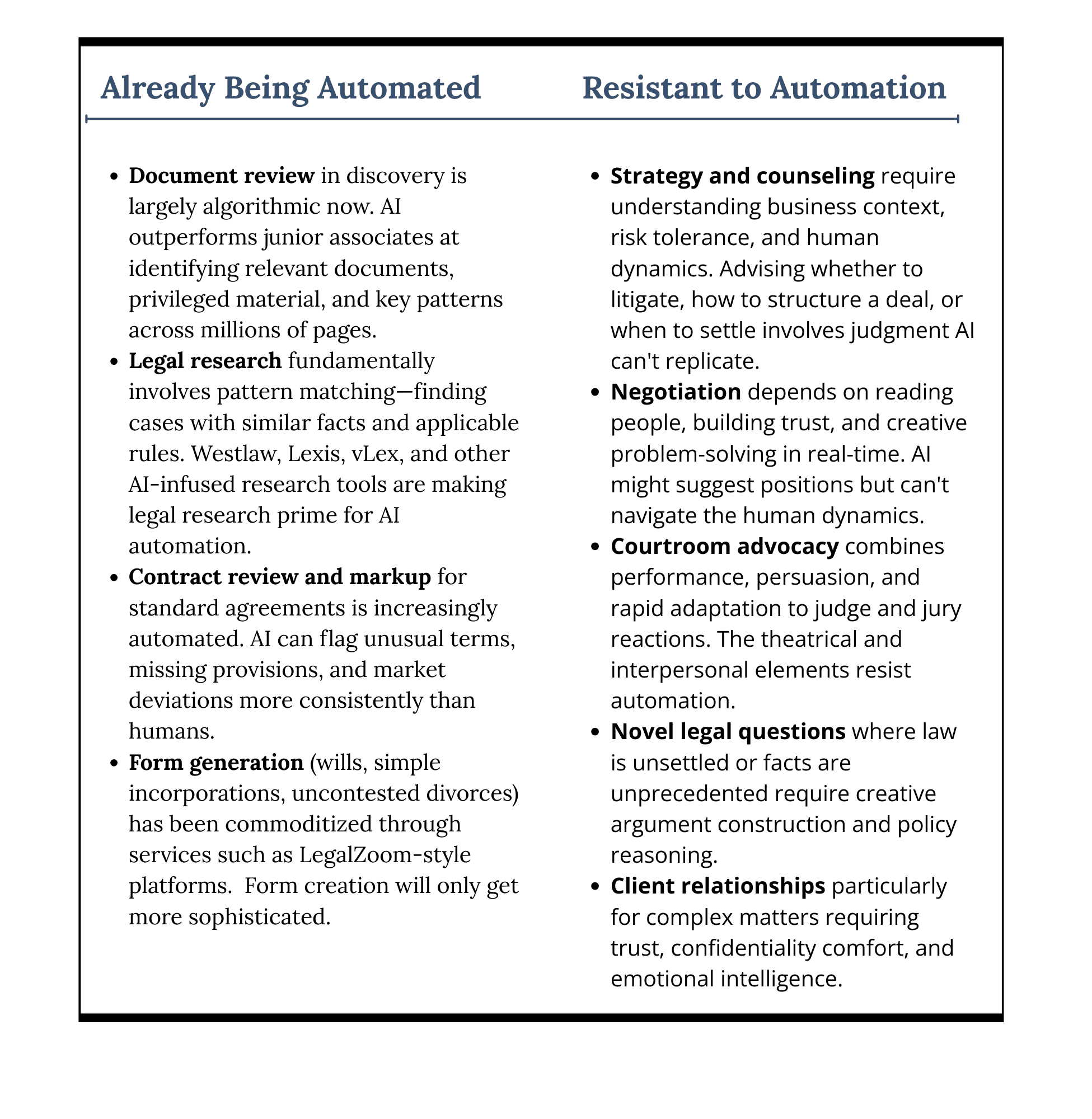
How are we seeing this play out in actual law firms?
The Emerging Model
Most law firms adopting AI tools are doing so to reduce costs and improve speed and accuracy, while retaining a high amount of human involvement in strategic thinking, novel argument creation, and client-facing tasks. In short, many firms are evolving to a hybrid approach, that can look like this:
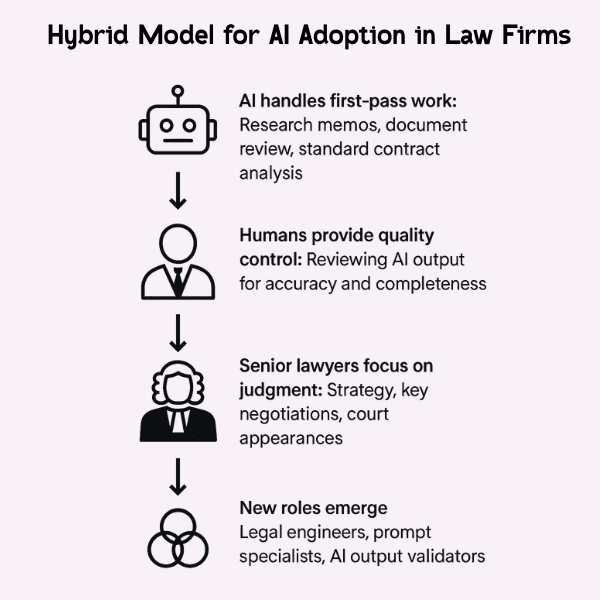
Critical Uncertainties
AI use in law raises several critical concerns, such as the unauthorized practice of law, malpractice liability, insurance coverage of AI-influenced work product, and attorney competence using AI. These uncertainties will need to be addressed in a subsequent article.
The Hope of AI Adoption
In a perfect world, AI would do all the tasks we don’t want to do, and free us up to spend our time and efforts on what we want to do. Ideally, AI handles drudgework and automating routine tasks, allowing you to focus on what you went to law school for: crafting novel arguments, solving complex problems, trusted advisory relationships, and meaningful advocacy.
But as of yet, this is only happening in limited cases. In-house counsel benefit most clearly. They can automate routine contract review, focus on strategic business partnerships, spend more time on preventive law, and engage more deeply with business operations and client relationships. Solo and small firms stand to gain a strategic gain in capabilities by automating tasks that are low or no-yield. This allows them to serve clients better at lower price points.
There are, however, several tensions that have prevented us from seeing these gains on a widespread basis.
Three Critical Tensions
1. The Business Model Problem
Law firms traditionally profit from what is essentially a pyramid structure where associate hours on routine work subsidize partner time. If AI eliminates 70% of associate tasks, what happens to law firm economics? Do we need fewer lawyers or different lawyers? Many firms are struggling with the billing transition—they can't bill AI time at associate rates, but they haven't figured out alternative fee structures. And an issue that many worry about, but few have answers for, how do entry-level attorneys learn if AI does entry-level work?
The second tension is brought about as a ‘growing pain’ of adopting and adjusting to AI use in our law firms, the Skills Gap.
2. The Skills Gap
Ideally AI frees all lawyers to avoid the drudge work, the mind-numbing search through stacks of documents, and the creation of necessary documents such as privilege logs. But not every lawyer doing routine work can seamlessly shift to high-judgment tasks. Document review attorneys who built careers on pattern recognition will not easily shift to strategic thinking. Associates whose strength is thoroughness, not creativity will not find it easy to create meaningful, winning case strategies and arguments. And practitioners in commoditized areas without easy pivots could find themselves without a role in this AI-rich territory. The optimistic "we'll all do higher-value work" assumes fungibility that doesn't exist.
The third question is perhaps the most volatile. The one that brings us as a profession closest to the Luddites in early 1800 England: do we need as many lawyers as we have?
3. The Volume Question
If AI makes legal services 10x more efficient, do we need the same number of lawyers doing “elevated” work? Or do we need far fewer lawyers, even if they're all doing sophisticated tasks? Corporate clients are betting on the latter—they want the same outcomes with lower legal spend, not the same spend on enhanced services.
So does "elevation" actually happen or do jobs just disappear? Early data suggests both—some lawyers genuinely focus on higher-value work, while others exit the profession.
Who Captures the Value AI Creates?
Clients (lower fees)?
Law firms (higher margins)?
Tech companies (software costs)?
Consumers (access to justice)?
Currently, tech companies and clients are winning; law firms are squeezed.
The Inevitable Shift, and How to Prepare For It
NALP's Executive Director warns that firms are going to expect future first year associates to start performing like today's fourth year associates on a much shorter runway. The composition of law firms is evolving, with a shift towards more experienced lateral hires, growth in two-tier partner structures, and a reduction in junior associate hiring. The median number of offers per law firm office decreased from seven in 2023 to six in 2024. The total number of summer associate offers in 2024 was down even further from the 11-year low measured in 2023, while the median number of summer associate offers per law firm office fell to just six in 2024, the lowest since NALP began tracking that figure in 1993.
This dynamic reflects a strategic preference for associates who can bill immediately and require minimal training ramp-up. Candidates with two to five years of specialized experience—especially in hot fields like cybersecurity, ESG, and international arbitration—now command significant signing bonuses.
Law schools need to reconsider large law school class sizes for the class of 2028, 2029, and beyond, when we can predict with some pretty good certainty that Gen AI is changing the business models of firms and their hiring practices.
AI isn't eliminating jobs, YET. Although AI might not be eliminating an appreciable number of jobs from our profession, it is already changing the value proposition. Firms are questioning whether they need as many entry-level lawyers if AI handles basic tasks. If you are worried about your law job, here are some strategies to help you stay valuable.
Evidence-Based Strategies That Work
1. Move to High-Judgment Work
Lawyers with two to five years of specialized experience—especially in hot fields like cybersecurity, ESG, and international arbitration—now command significant signing bonuses. Focus on emerging, complex areas where rules are unsettled and precedent is sparse. And then work to become as knowledgeable about it as possible; a “lawyer to the lawyers.”
2. Become the AI-Attorney Hybrid
As AI takes on more routine tasks, remember that someone still needs to:
Architect the AI prompts
Quality-control the output
Make strategic decisions
Interface with clients
Become indispensable at these tasks as quickly as possible.
3. Own Client Relationships
Every analysis about AI in law firms emphasizes that relationships remain human. But “relationships” isn't enough—you need to go beyond:
Understand client business deeply. Understand what the driving force is for your clients, even ones that might be “one and done.” They will have friends and associates who need legal work. You want to stand out so that they remember and recommend you.
Provide strategic counsel, not just legal answers. This usually requires asking more questions, listening, and understanding.
Become the trusted advisor on risk, not just compliance.
Offer judgment on “should do” not just “can do.” A fundamental part of what lawyers do is to offer options to clients. Now you need to step that up by offering a suggestion of what they should do, and most importantly, why. This is fundamental in developing those trusted relationships.
4. Develop Rare Specializations
Develop a specialization in an area that will continue to increase in importance. Fields such as data privacy (GDPR, CCPA, AI-ethics), renewable energy (permitting, tax-credit modeling), ESG reporting, infrastructure finance, AI Governance, and international arbitration will see an increased need for legal expertise, not a decrease.
Or go deeper—become THE expert on AI-adjacent issues such as AI liability in autonomous vehicles, AI-related IP issues, blockchain securities regulation, synthetic biology IP, or something where expertise is scarce, and the stakes are high.
5. Master Soft Skills
Courtroom advocacy, negotiation, mediation—these require reading humans in real-time, adapting to emotional dynamics, performing under pressure. AI can prep you for these situations, but can't do this for you.
The Luddite period saw massive displacement before new equilibrium. Similarly:
If you're a junior associate doing routine work: Start developing specialized expertise NOW. Take on client-facing, more complex matters even if you’re doing so pro bono. Learn AI tools better than more senior-level attorneys.
If you're mid-level: Stop delegating down, start building up. Become the architect of AI-enhanced service delivery, develop AI workflows, and figure out how to benefit the firm with your knowledge. Expand beyond just reviewing junior associate work product.
If you're senior: Your relationships and judgment are valuable—but only if you adapt, as some point clients will refuse to pay for inefficiency disguised as “personal service.”
Search for ways to create value for your firm. Develop new roles that couldn't exist without AI but can't be done by AI alone. This will allow you to find the equilibrium far more quickly.
Practical Next Steps to Take Today
Pick an AI tool and become expert at it—not just competent. Learn on your own time if necessary, and offer to teach a seminar or CLE to the other firm members on how to use it safely and effectively.
Identify your unique value beyond “I review documents carefully.”
Develop expertise in an emerging area with no established playbook. Areas such as AI governance, AI ethics and laws, the GDPR, CCPA, Privacy laws and cybersecurity are all good places to start.
Build direct client relationships based on business understanding, not legal knowledge.
Create new service models that assume AI does the grunt work. This means creating legal work flows that benefit the firm.
Conclusion
An inevitable shift is coming, and much like the Luddites, we need to decide--for ourselves, and for the profession in general--how to handle it. Destroying the mega-sized data centers that AI needs to run is not an option, nor would it be practical or beneficial. The Luddites weren't wrong that machines would destroy their specific jobs. They were wrong in thinking they could stop it. They fought to preserve the old model. At the Rowe and Dunscough Mill, four of the people who burned it, trying to protect their jobs, actually lost their lives. The skilled weavers who survived learned to operate power looms and became factory supervisors. Similarly, lawyers who thrive will be those who master AI tools, not those who resist them.
© 2025 Amy Swaner. All Rights Reserved. May use with attribution and link to article.
More Like This

What I Hate About Minnesota’s Nudification Statute
Minnesota’s new nudification law targets an urgent harm, but its “technical skill” exemption creates a troubling loophole: easy tools are banned, while the same nonconsensual image may escape liability if it took more work to create.

‘Reports of My Death Have Been Greatly Exaggerated’ — Prompt Engineering
Prompt engineering isn’t dead—it has grown up, replacing tricks and flattery with a more thoughtful approach that helps lawyers give AI better context, set clearer boundaries, and produce more reliable results.

Why Solo and Small Law Firms Lag in AI Adoption—And How to Change That
Solo and small-firm lawyers make up most of the U.S. bar, yet five structural barriers are slowing their AI adoption—and practical, focused tools may be the key to closing the gap.

