
AI in Legal Practice

Amy Swaner
Calculating...
TL; DR A Nevada court split an expert witness’s ChatGPT history into four parts. The court required production only of the AI-generated case summaries the expert considered. His prompts, his deposition preparation, and his draft-report material stay protected. The decision adds an expert-discovery layer to the framework I drew from Heppner and Warner.
In April, I wrote that Heppner and Warner, the first two AI privilege decisions, agreed far more than early commentary suggested. Both courts applied old rules to a new tool. Neither held that using AI, standing alone, waives protection.
Another federal court has now weighed in, from a different direction: a testifying expert’s ChatGPT log.
On September 29, 2026, U.S. District Judge Anne R. Traum ruled on whether a plaintiff’s expert must hand over his ChatGPT history. Villanueva v. Las Vegas Metropolitan Police Department, 2026 WL 2942348, (D. Nev. Sept. 29, 2026). Her answer: some of it.
The decision confirms most of my April framework, and it adds a problem the first two cases did not consider. What happens when an expert treats AI output as source material?
What Happened
Villanueva is a civil rights excessive-force case against the Las Vegas Metropolitan Police Department and one of its officers. The AI issue came up through the plaintiff’s use-of-force expert, Tom Melton.
The deposition. At his October 1, 2025 deposition, Melton testified that he used ChatGPT to help research and draft his expert report. He also testified that he sometimes copied and pasted ChatGPT’s output into the report.
The missed disclosure. Defendants had already subpoenaed “all data, documents, and other information considered” by the expert. Plaintiff had not disclosed the ChatGPT use in response. The AI use surfaced at the deposition, not in the subpoena response.
The privilege log. Plaintiff refused to produce the 40-page ChatGPT history and logged it as attorney/expert work product and trial-preparation material.
The magistrate’s ruling. On December 23, 2025, Magistrate Judge Albregts ordered the entire log produced from the bench. He held Melton “considered” it in forming his opinions, that it was not a draft report, and that no attorney-client privilege applied. He did not review the log himself. He relied on plaintiff’s description of how Melton used ChatGPT.
Plaintiff’s objection. Judge Traum reviewed the log in camera, after plaintiff objected. She found the order to produce all of it clearly erroneous or contrary to law. She also held that the magistrate judge did not clearly err by skipping in camera review and relying on plaintiff’s good-faith description of the log. She then sorted the log by what Melton used each part for.
One ChatGPT History, Four Results
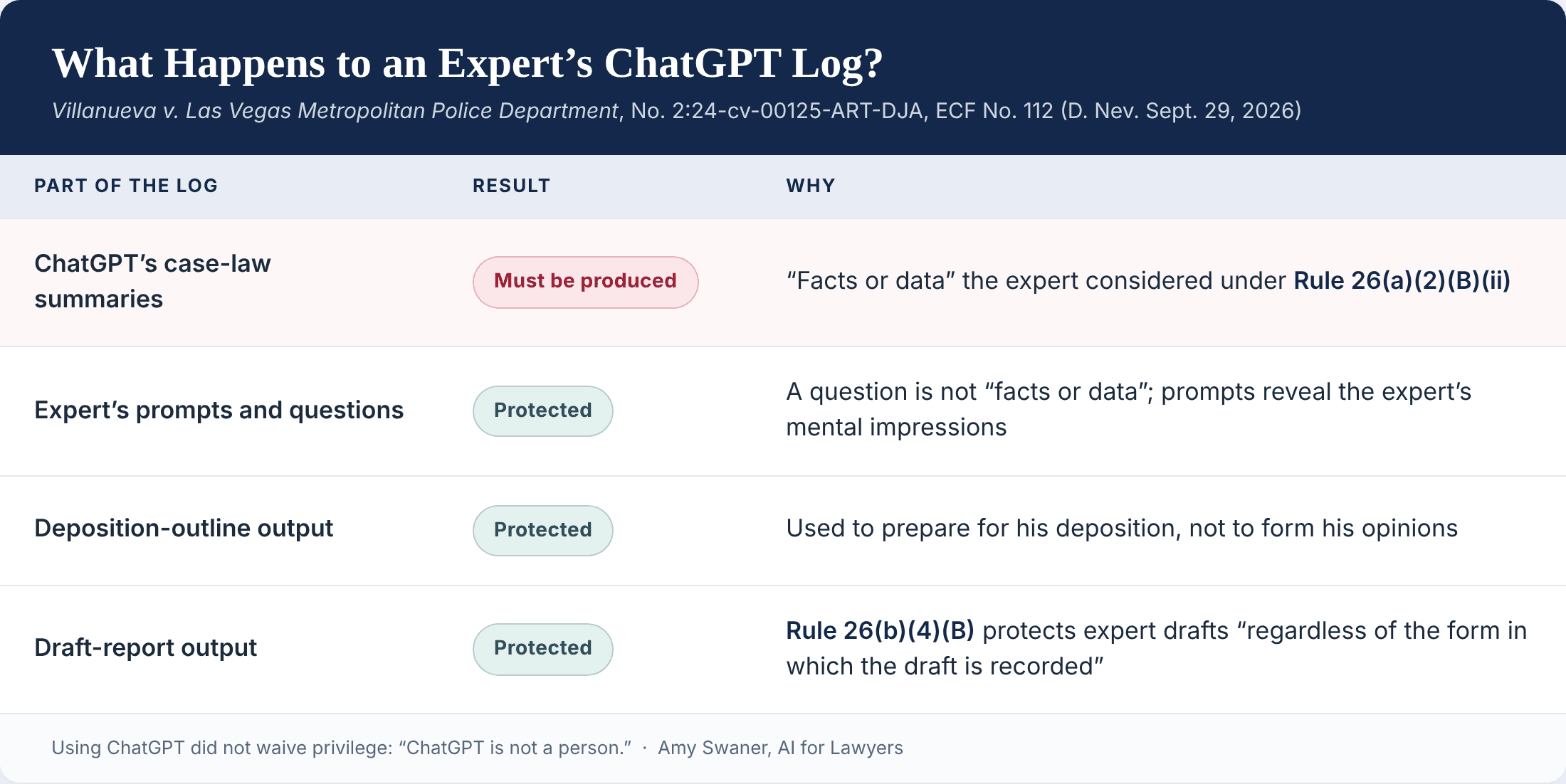
What Melton did with each part of the conversation mattered more than the fact that all of it happened in ChatGPT.
On the issue of waiver, Judge Traum held: “Because ChatGPT is not a person, but was an application used in this instance as a research, drafting, and editing program, the Court finds that any privileged information is not waived by Melton’s use of the program.”
What Villanueva Confirms About My Five Takeaways from the First Two AI Privilege Decisions
As a refresher, these were my five takeaways in Five Takeaways from the First Two AI Privilege Decisions (Apr. 6, 2026):
AI Does Not Automatically Waive Privilege—But Carelessness Does
AI Tools Are “Tools, Not Persons”—And Gives Weight to the Work Product Analysis
A Pro Se Plaintiff Is More Closely Positioned as an Attorney, than a Client.
The Vendor’s Privacy Policy Is Important
Attorney Direction—The Through-Line Both Courts Agree On; Document It
Here’s how they held up against Judge Traum’s order in Villanueva.
Using AI Does Not Automatically Waive Protection
My first takeaway in April was that neither court held AI use, standing alone, waives privilege or work product. Check. Villanueva holds the same. The expert used a general-purpose chatbot to research and draft, and most of what he did with it stayed protected. It is looking more and more safe to say that AI use doesn’t automatically waive privilege. That argument has now failed in Michigan and Nevada.
Not Surprisingly, AI Tools Are Tools, Not Persons
Judge Traum’s waiver holding closely tracks Warner v. Gilbarco, where Magistrate Judge Anthony P. Patti wrote that “ChatGPT (and other generative AI programs) are tools, not persons, even if they may have administrators somewhere in the background.” Villanueva does not cite Warner. But it reaches the same conclusion. Two courts, separate districts, the same reasoning. And reasoning that I strongly agree with.
Pro Se Status: Not Tested
Villanueva does not test my third takeaway, on pro se litigants. The protection here came from Melton’s status as a retained testifying expert.
Ordinary Doctrine Does the Work
Judge Traum created no new AI privilege, discovery, or evidentiary rule. She didn’t need to. She took the categories Rule 26 already contemplates (facts or data considered, drafts, and mental impressions) and sorted each part of the log into the category it fit. That is exactly what Heppner and Warner did with privilege and work product. The same old rules we’ve been using apply nicely to AI.
Attorney-Client Privilege vs. Work Product
In April, I drew a distinction that I still think is the most important issue to come out of these cases: Work Product is the stronger protection in relation to AI use. Consider Judge Patti’s framing in Warner: generative AI programs “are tools, not persons.” That is a strong argument for work product, which is generally waived only by disclosure to an adversary or in a way likely to reach one. It does less for attorney-client privilege, which can be waived by disclosure to any third party, including, under Heppner, the AI vendor.
Warner applied the tools reasoning to work product. Villanueva applies it to “any privileged information,” without distinguishing attorney-client privilege from work product. I disagree with collapsing the two doctrines. Here, it does no harm. No one claimed attorney-client privilege; plaintiff asserted only work-product and trial-preparation protection. The protections Judge Traum actually applied (expert drafts and mental impressions) are work-product-type protections. But we can’t cite Villanueva for “using ChatGPT never waives privilege”; it doesn’t get us all the way there. Heppner points the other way for privilege. In a footnote, Judge Rakoff wrote that even if Heppner put privileged information into Claude, he waived the privilege by sharing it with the vendor, “just as if he had shared it with any other third party.”
My April advice stands, with one refinement. Lean on work product but analyze both protections and assert each one where it applies. Do not assume attorney-client privilege survives any third-party AI tool. Consumer tools carry the most risk. And free tiers should never be used with confidential information.
The Vendor’s Privacy Policy
My fourth takeaway was that the vendor’s privacy policy is now evidence. In Heppner, Anthropic’s consumer privacy policy was the factual foundation for finding no reasonable expectation of confidentiality.
Villanueva never mentions OpenAI’s terms. The order does not say which version of ChatGPT Melton used, whether he had turned off model training, or whether anyone raised the issue. We cannot tell from the order whether the parties argued it at all.
For work product and expert drafts, that silence may be defensible. Confidentiality matters less when waiver generally requires disclosure to an adversary. But please do not read Villanueva as permission to ignore your tools’ terms. Likewise, warn your clients about their use of AI.
Attorney Direction
My fifth takeaway called attorney direction the ‘through-line of both decisions.’ Heppner denied work product in part because defense counsel did not direct the defendant to use Claude. Villanueva never needs to address this issue. Nothing in the order says whether plaintiff’s counsel told Melton to use ChatGPT or even knew he was using it. But Melton wasn’t a client. Melton was an expert. And so protection came from:
The expert’s status. Rule 26(b)(4)(B) protects a retained expert’s drafts, whoever directed the drafting.
An extension of the mental-impressions rule. Judge Traum applied Rule 26(b)(3)(B), which protects the mental impressions of “a party’s attorney or other representative,” to the expert’s prompts and outputs.
That second step is the weakest part of the order. The 2010 amendments protect expert drafts and most communications between lawyers and their experts. They did not clearly create a shield for a testifying expert’s own thinking. For extending work product to experts, Judge Traum cited one 2015 Eastern District of California decision, Coppola v. Smith, 2015 WL 1537574, at *6 (E.D. Cal. 2015). She did not otherwise explain the extension.
The bigger problem is the Ninth Circuit case she relied on. Judge Traum quoted Mackay for the point that the 2010 amendments were meant to protect “opinion work product—i.e., attorney mental impressions, conclusions, opinions, or legal theories.” That language is about attorneys. And Mackay’s holding cuts the other way: Rule 26(b)(3) does not give presumptive protection to all of a testifying expert’s materials, and the 2010 amendments did not change that. Republic of Ecuador v. Mackay, 742 F.3d 860 (9th Cir. 2014). The Eleventh Circuit agrees. Republic of Ecuador v. Hinchee, 741 F.3d 1185 (11th Cir. 2013). As far as the order shows, Judge Traum did not address that tension.
It also puts Villanueva closer to Shih v. Petal Card, the decision Judge Rakoff “respectfully disagree[d]” with in Heppner. Shih protected litigation materials whether or not a lawyer directed the work.
My bottom line: expect other courts to follow the case-summary and draft-report holdings. Do not count on the protection for prompts outside the District of Nevada and be careful relying on it inside it.
What Villanueva Adds
A Protected Log Can Still Produce Discoverable Material
Heppner and Warner addressed the issue: does using AI waive protection? Villanueva is in a similar vein, but relevant to an expert’s use of AI. Namely, what must an expert disclose?
Rule 26(a)(2)(B)(ii) requires a testifying expert’s report to include “the facts or data considered by the witness in forming” the opinions. The Ninth Circuit reads that broadly. It covers “any material considered by the expert, from whatever source, that contains factual ingredients,” not only what the expert relied on. Republic of Ecuador v. Mackay, 742 F.3d 860, 869 (9th Cir. 2014).
Melton had ChatGPT summarize the leading excessive-force cases, and he read those summaries while forming his opinions. Judge Traum held that the summaries are “facts or data” Melton considered under Rule 26(a)(2)(B)(ii). So they are fair game for the opposing party, even though his prompts, his deposition prep, and his drafts stay protected.
Judge Traum relied on Hirata v. Southern Nevada Health District, 2016 WL 10706085 (D. Nev. 2016), which held that an expert “considered” deposition summaries even though he used them only as a quick-reference guide. An AI case summary gets the same treatment as a summary a paralegal prepares.
Hallucinations Matter, In Several Ways
Hallucinations are nearly always an annoyance and drawback for those using AI for legal work. But here, defendants turned the risk of hallucinations into a reason to get the summaries. The log, they argued, is the only place to find any hallucinated case citations, quotes, or legal standards the expert relied on or considered. Judge Traum agreed that the log was the only place to look. The order does not find that any hallucinations actually occurred.
Think about what that means for cross-examination. If an expert’s opinion rests on an AI summary of a case, opposing counsel can now get the summary and compare it to the real opinion. A single invented holding becomes impeachment material. Judge Traum said as much: concerns about the expert’s methodology and reliance on ChatGPT are matters for impeachment at trial.
Purpose of the AI Use Decides Whether It Is Protected
The court did not treat the log as one document. It sorted entries by what Melton used them for, as the table above shows.
So the same tool and the same log produced both protected and discoverable material. An expert who mixes research and drafting in one long conversation makes that sorting harder and leaves more of the line-drawing to a judge reading the log in camera.
What Lawyers Should Do Now--Best Practices for Using AI, and for When Experts Are Using AI
My April best practices still apply:
use a tool with privacy protections,
understand the vendor’s terms,
document attorney direction to use AI,
adopt a written AI policy,
advise clients about using AI on their own and
consider work product as having the stronger protections in litigation.
Villanueva caused me to consider best practices for anyone who retains a testifying expert.
If You Retain an Expert:
Ask about AI use at the first call. In Villanueva, the expert’s AI use came out at his deposition, after it had been left out of the subpoena response. From here out, you’re safest to assume any expert you hire is using AI. Before retaining them, ask how they use AI, what tool(s) they are using, and what privacy protections the tool provides. Ask again before you serve the report.
Put it in the engagement letter. Several things are important enough to go into your engagement letter with the expert. Require the expert to tell you before using any AI tool on the matter, to use an enterprise account or another tool whose terms restrict retention, training, and disclosure to third parties, and to keep the full history without deleting any of it. Turning off model training alone is not enough. Heppner turned on the vendor’s reserved right to disclose user data, not just on training.
I've posted sample engagement-letter language for expert AI use on my Substack. It's free to subscribers.
Tell the expert to keep research and drafting in separate conversations. The court sorted the privilege log by purpose. Separate conversations will not change what must be disclosed, but they make the sorting cleaner and leave less to a judge’s in camera review. The decision binds no one, but this is good practice regardless.
Require the expert to tell you what AI-generated information or research helped inform their decision. And then be prepared to disclose that information. List it with the report’s facts and data. Late disclosure invites a motion to compel and sets you on the wrong foot, with a potential credibility problem. It can also cost you the evidence. Under Rule 37(c)(1), a party that fails to make a required Rule 26(a) disclosure may not use that information at a hearing or at trial unless the failure was substantially justified or harmless.
Prepare the expert to testify about AI use. How they used it, what they verified, and what they wrote themselves. Make sure your expert is ready for questioning about their AI use. Experts are far too expensive to have their testimony impeached when preparation and good governance would have prevented it.
Check every AI case summary against the actual opinion. Assume the other side will get any summary your expert considered and will look for invented holdings. Get there before they do.
If you are on the other side:
Ask about AI use in every expert deposition and in your expert discovery requests. Which tool, for what, and whether any output went into the report.
Ask for the outputs the expert considered. As Judge Traum concluded in Villanueva, research summaries are discoverable even when prompts and drafts are not.
Check every case the expert cites. No surprises. If the expert’s legal premises came from an AI summary, that summary is the most likely place for a fake cite. Check not only the cites, but the pin cites, as well. And since hallucinations don’t end with case citations, check all reports, articles, and scholarly work relied on as well.
Note: Villanueva applies the federal rules to a retained testifying expert. If you practice in state court, check whether your state’s rule tracks the 2010 federal protections for expert drafts and attorney-expert communications.
The Bottom Line
Villanueva is a district court ruling on objections to a magistrate judge’s discovery order. Binding on no one outside the case. It is persuasive authority at best everywhere else, including the Eighth Circuit.
But it offers a practical roadmap for working with expert witnesses in the Age of AI. Under Mackay and Rule 26(a)(2)(B)(ii), AI-generated research that an expert considers is disclosable like any other source material. That makes sense, and I expect other courts to follow that part of the decision. The protection for prompts stands on weaker footing.
Heppner, Warner, and Villanueva each decided how AI use affects protection or disclosure, and none of them needed new law. AI-generated or not, the same rules apply.
© 2026 Amy Swaner. All Rights Reserved. May use with attribution and link to article.
More Like This
When Your Expert Witness Uses AI
A Nevada federal court ruled that AI-generated research considered by an expert may be discoverable, while prompts, drafts, and deposition prep may remain protected.

The Case of Amazon v. Perplexity
Amazon’s fight with Perplexity raises a bigger question: who controls—and profits from—the customer relationship when AI does the shopping?

What I Hate About Minnesota’s Nudification Statute
Minnesota’s new nudification law targets an urgent harm, but its “technical skill” exemption creates a troubling loophole: easy tools are banned, while the same nonconsensual image may escape liability if it took more work to create.

